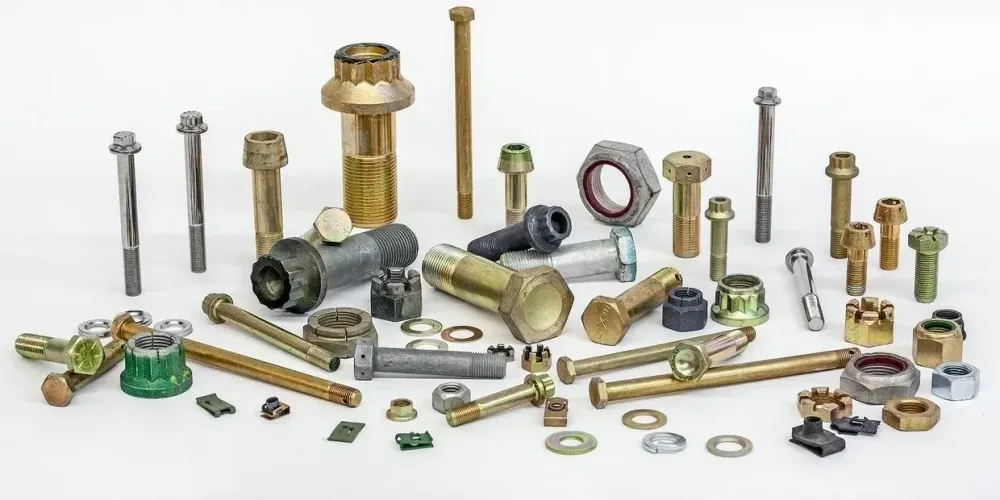
Fastener standards, charts and calculators for the bench: bolt finder, torque and weight calculators, grades, markings, threads, coatings and corrosion. Start with the bolt finder →
Find a size and its dimensions to DIN, ISO, IS and NF E, check threads, grades and markings, work out torque and weight, choose rivet nuts and blind rivets, then check coatings and corrosion.
Interactive
Bolt finder
Pick a metric size to see everything about it at once.
Dimension tables
Fastener dimensions to DIN, ISO, IS and NF E
93 fastener types covering the standards on our DIN chart: bolts and machine screws, tapping and wood screws, studs, eye bolts, nuts, washers, pins, circlips, rivets, threaded rod and the French NF E standard fasteners (hex bolts, hex nuts, heavy flange bolts, Z / M / L / LL plain washers, CS and CL conical washers). Where DIN, ISO, IS and NF E differ, each standard has its own tab and the values that change are shaded, so you can see at a glance which sizes are not interchangeable. Click any row to update the drawing.
For information only. Values are nominal, taken from the standards as published (checked October 2026). Standards are revised: always check the current edition named on your drawing before production or inspection.
Threads
Thread, drill and clearance hole chart
Metric ISO threads. Clearance holes per ISO 273: fine for accurate location, medium for general use, coarse for site work.
Thread
Coarse pitch
Fine pitch
Tapping drill
Clearance fine
Clearance medium
Clearance coarse
Spanner ISO (DIN)
Allen key (cap screw)
M3
0.5
0.35
2.5
3.2
3.4
3.6
5.5
2.5
M4
0.7
0.5
3.3
4.3
4.5
4.8
7
3
M5
0.8
0.5
4.2
5.3
5.5
5.8
8
4
M6
1.0
0.75
5.0
6.4
6.6
7.0
10
5
M8
1.25
1.0
6.8
8.4
9.0
10.0
13
6
M10
1.5
1.25 / 1.0
8.5
10.5
11.0
12.0
16 (17)
8
M12
1.75
1.5 / 1.25
10.2
13.0
13.5
14.5
18 (19)
10
M14
2.0
1.5
12.0
15.0
15.5
16.5
21 (22)
12
M16
2.0
1.5
14.0
17.0
17.5
18.5
24
14
M18
2.5
1.5
15.5
19.0
20.0
21.0
27
14
M20
2.5
1.5
17.5
21.0
22.0
24.0
30
17
M22
2.5
1.5
19.5
23.0
24.0
26.0
34 (32)
17
M24
3.0
2.0
21.0
25.0
26.0
28.0
36
19
M27
3.0
2.0
24.0
28.0
30.0
32.0
41
19
M30
3.5
2.0
26.5
31.0
33.0
35.0
46
22
M36
4.0
3.0
32.0
37.0
39.0
42.0
55
27
Threads
Inch (UNC / UNF) sizes and nearest metric
For imported machinery and US drawings. Do not mix inch and metric threads: they may start but will strip.
Size
Diameter (mm)
UNC (TPI)
UNF (TPI)
Nearest metric
Spanner (in)
#10
4.83
24
32
M5
3/8
1/4"
6.35
20
28
M6
7/16
5/16"
7.94
18
24
M8
1/2
3/8"
9.53
16
24
M10
9/16
7/16"
11.11
14
20
M11 / M12
5/8
1/2"
12.70
13
20
M12
3/4
5/8"
15.88
11
18
M16
15/16
3/4"
19.05
10
16
M20
1-1/8
7/8"
22.23
9
14
M22
1-5/16
1"
25.40
8
12 (14 UNS)
M24
1-1/2
Grades & materials
Property classes: steel bolts and nuts
ISO 898-1 (IS 1367 Part 3 in India). Read the class as two numbers: the first × 100 is the minimum tensile strength in MPa, and the first × second × 10 is the minimum yield. A 10.9 bolt: 1000 MPa tensile, 90% of that as yield.
Class
Min. tensile (MPa)
Min. yield / 0.2% proof (MPa)
Proof stress (MPa)
Core hardness
Matching nut
Typical use
4.6
400
240
225
67–95 HRB
Class 5
Light fabrication, non-critical
5.6
500
300
280
74–95 HRB
Class 5
General fabrication
8.8 (≤ M16)
800
640
580
22–32 HRC
Class 8
Structural and general engineering
8.8 (> M16)
830
660
600
23–34 HRC
Class 8
Structural and general engineering
10.9
1040
940
830
32–39 HRC
Class 10
Machinery, automotive, high-load joints
12.9
1220
1100
970
39–44 HRC
Class 12
Socket cap screws, dies and tooling
Rule: always use a nut of the same or higher class than the bolt. A weaker nut strips before the bolt reaches its strength.
Grades & materials
Reading head markings
Metric steel bolts from M5 up carry the class and the maker's mark on the head. Stainless shows the grade. Inch (SAE) bolts use radial lines instead of numbers.
Class 8.8Metric hex bolt, medium strengthClass 10.9Metric hex bolt, high strengthClass 12.9Socket cap screws, usually blackA2-70Stainless 304 familyA4-80Stainless 316 familyASTM A193 B7Stud end markingSAE Grade 53 radial lines, ~120 ksiSAE Grade 86 radial lines, ~150 ksi
Grades & materials
Stainless steel grades
ISO 3506-1. The letter and digit give the steel group, the number after the dash × 10 gives the minimum tensile strength in MPa.
Grade
Steel
Min. tensile (MPa)
Min. 0.2% proof (MPa)
Corrosion
Where to use
A1-70
303 (free machining)
700
450
Fair
Indoor, dry
A2-70
304
700
450
Good
General outdoor, food machinery, buildings
A4-70
316
700
450
Very good
Coastal, marine, chemical and pharma
A4-80
316
800
600
Very good
Stronger marine and chemical joints
C1-70
410 (martensitic)
700
410
Fair
Hardened self-drilling screws
Duplex D4 / 2205
1.4462
800
600
Excellent
Offshore, desalination, high chlorides
Quick choice: dry indoors, A2 is enough. Near the sea, swimming pools or chemicals, use A4. Stainless threads can gall; use anti-seize on A2 / A4 nuts and bolts.
Grades & materials
ASTM studs and nuts for pressure service
Common pairings for flanges, valves and pressure vessels.
Stud
Material
Min. tensile
Matching nut
Service
A193 B7
Cr-Mo alloy steel
125 ksi (860 MPa), up to 2½"
A194 2H
High temperature and pressure
A193 B7M
Cr-Mo, hardness-limited
100 ksi (690 MPa)
A194 2HM
Sour (H₂S) service, NACE MR0175
A193 B16
Cr-Mo-V alloy steel
125 ksi (860 MPa), up to 2½"
A194 4 / 7
Higher temperature than B7
A193 B8 / B8M
SS 304 / SS 316
75 ksi (515 MPa), class 1
A194 8 / 8M
Corrosive service
A320 L7
Cr-Mo alloy steel
125 ksi (860 MPa), up to 2½"
A194 4 / 7
Low temperature, down to −101 °C
A453 660
A286 superalloy
130 ksi (895 MPa)
A453 660
Very high temperature
Grades & materials
Hardness conversion (approximate)
Useful when a drawing and a test certificate use different scales. Values per ASTM E140 tables, rounded.
Rockwell C (HRC)
Rockwell B (HRB)
Vickers (HV)
Brinell (HB)
Approx. tensile (MPa)
—
60
110
107
~370
—
70
125
122
~420
—
80
150
145
~500
—
90
185
176
~600
20
~98
238
226
~770
25
—
266
253
~860
30
—
302
286
~960
35
—
345
327
~1110
40
—
392
371
~1250
45
—
446
421
~1450
50
—
513
481
~1700
Interactive
Tightening torque calculator
Preload is set to 75% of the proof load (ISO 898-1 proof stress for steel, 0.2% proof stress for stainless). Torque = K × preload × diameter.
For guidance only. Follow the torque given on your drawing or by the equipment maker, and use a calibrated torque wrench.
Interactive
Fastener weight calculator
Choose any DIN, ISO, IS or NF E standard, then the size, length and material, to get the weight per piece, per 100 and per 1000, and how many pieces make a kilo. Useful for quotes, dispatch and freight.
How the weight is worked out. Every standard in our dimension tables is listed (DIN, ISO, IS and NF E). Each result carries a label so you know how exact it is:
Standard table the mass published for that standard (kg per 1000 pcs, steel 7.85 g/cm³), for 46 standards including DIN 931, 933, 912, 934, 985, 125, 9021, 127, 7991, 7985, 965, 913, 916, 7984, 6912, 603, 6921, 84, 7, 1481, 471, 472, 975, 580 and 582. Between two listed lengths the value is interpolated; beyond the longest listed length it is extended at the table’s own weight per mm.
Table-corrected no table for this exact standard or length: calculated from its own dimensions, then corrected with the published table of the same part (for example ISO 4014 with DIN 931, ISO 4032 with DIN 934). Typically within ±2–3 %.
Calculated no published table exists: calculated from the standard’s dimensions, with the tolerance shown.
Published tables are nominal values; real parts vary with tolerances, thread rolling and head forming. Zinc plating adds under 1 %, hot-dip galvanising about 3–6 %. Other materials are scaled by density. For invoicing, confirm with the weight of a sample batch.
Product selector
Rivet nut (nut insert) selector
Work through the steps the way the big fastener catalogues do: application, material, head, body, end, thread and grip. Every part number, grip range and length comes from our own size tables.
Hole Ø equals the body Ø with tolerance +0.1 / 0; hex bodies need a hex hole across flats. Before production, set the tool stroke with a trial setting in your own sheet.
Product selector
Blind rivet (pop rivet) selector
Choose the rivet type, diameter and material, then the thickness and material of your parts. You get the drill size, a suggested length, the strength per rivet, how many rivets your load needs, and a design check for the joint.
Strengths are typical minimum values per rivet from our product data. Head and mandrel dimensions are typical for dome heads to ISO 15977. The suggested length is a rule of thumb (grip + about 1 × d); confirm against the grip chart for production.
Product guide
Sheet metal fasteners: holes and sheet hardness
Self-clinching parts must be harder than the sheet. Blind rivets and rivet nuts need the right hole: too small and they will not enter, too big and they spin.
Sheet
Typical hardness
Clinch fastener to use
Aluminium
HRB ≤ 50
Aluminium, steel or stainless clinch fasteners
Mild steel / CRCA
HRB ≤ 70–80
Steel or stainless clinch fasteners
Stainless 304 / 316
HRB ≤ 88–92
Hardened 400-series or A286 clinch fasteners
Size
Blind rivet hole
Rivet nut thread
Rivet nut hole (round)
2.4 mm
2.5
M3
5.0
3.2 mm
3.3
M4
6.0
4.0 mm
4.1
M5
7.0
4.8 mm
4.9
M6
9.0
6.4 mm
6.5
M8
11.0
—
—
M10
13.0
—
—
M12
15.0 / 16.0
Finish & corrosion
Coatings and finishes
Choose a finish by where the joint will live. Salt-spray hours are typical values to red rust and depend on the exact specification.
Finish
Thickness
Salt spray (typical)
Best for
Watch out for
Zinc plated, clear / blue
5–8 µm
72–120 h
Indoors, dry outdoor
Rusts quickly near the sea
Zinc plated, yellow
8 µm
96–200 h
Machinery, electrical panels
Contains passivate colour
Zinc-nickel
8–12 µm
500–720 h+
Automotive, under-bonnet
Higher cost
Hot-dip galvanised (HDG)
45–85 µm
Decades outdoors
Structures, towers, outdoor steel
Nuts are tapped oversize; use HDG nuts
Zinc flake (Geomet, Delta-Protekt)
8–12 µm
480–1000 h
10.9 / 12.9 bolts, wind, automotive
No hydrogen embrittlement risk
Black oxide + oil
~1 µm
Very low
Socket cap screws indoors, tooling
Not for outdoor use
Phosphate + oil
5–15 µm
Low
Lubricated assembly, paint base
Store dry
Stainless, passivated
—
Inherent
Food, marine, chemical
Galling; isolate from aluminium in wet areas
Electroplating 10.9 and 12.9 bolts needs baking to avoid hydrogen embrittlement. Zinc flake coatings avoid the risk.
Finish & corrosion
Galvanic corrosion: which fastener in which metal?
In wet or salty conditions, two different metals form a battery and the less noble one corrodes. The fastener should be the more noble metal, because it is small next to the large part.
Fastener ↓ / Part →
Carbon steel
Galvanised steel
Stainless steel
Aluminium
Copper / brass
Zinc-plated steel
✓
✓
✕
!
✕
Stainless A2 / A4
✓
!
✓
!
✓
Aluminium
✕
!
✕
✓
✕
Brass / copper
!
✕
✓
✕
✓
Titanium
✓
!
✓
!
✓
✓ Good ! Use with care or isolate (nylon washer, sealant) ✕ Avoid in wet conditions
Panel hardware · Interactive
Panel hardware selector: lock, hinge, material and seal
Pick the kind of enclosure or door. The selector suggests the lock, hinge, material, gasket and protection rating that usually suit it, with links to the matching catalogue groups.
A starting point only. Check the grip range, load rating and cut-out of each series on its catalogue page, or ask our team to match parts to your drawing.
Panel hardware · Interactive
IP and IK rating decoder (IEC 60529 / IEC 62262)
Choose the two IP digits and the IK code to see exactly what protection an enclosure, lock or gasket offers, with the nearest NEMA type.
IP ratings cover the complete, correctly closed enclosure. A lock, gland or vent fitted later must have at least the same rating, and gaskets must be compressed as designed.
Panel hardware
Panel locks: cam, swing handle and rod control
How to choose a turning tongue (cam) lock, a swing handle lock or a multi-point rod control system, and which insert or key suits each application.
Lock type
How it works
Best for
Catalogue
Turning tongue (cam) lock
Quarter-turn: a cam (tongue) behind the door swings over the frame. Compression versions pull the door tight onto the gasket.
Small and medium doors, covers, meter boxes, control panels
Grip range: the door (panel) thickness the lock body clamps. Choose a series whose grip covers your sheet thickness, including any powder coat.
Cam length and offset: the cam must reach past the frame lip. Straight cams suit flush frames; cranked (offset) cams step forward or back to meet a recessed frame.
Rotation: 90° (quarter-turn) is standard; 180° and stop-free versions are available for special frames.
Compression: a compression cam moves the door inwards by a few millimetres as it turns, which is what keeps an IP54–IP66 gasket sealed.
Cut-out: most locks fit a D-cut or double-D cut-out, which stops the body turning. Take the exact size from the series page.
Insert and key types
Insert
Typical sizes
Where it is used
Square
7 mm, 8 mm
Electrical panels, distribution boards, machine cabinets
Triangle
7 mm, 8 mm, 9 mm
Utility, railway and street cabinets
Double-bit
3 mm, 5 mm
Switchgear and control cabinets, common in Europe
Slot / screwdriver
–
Low-security covers and service hatches
Hexagon
various
Machine guards where a tool is required by safety rules
Key cylinder
keyed alike, keyed different, master key
Restricted access, outdoor and public areas
Knob, wing or lever
–
Frequent access without a tool
Padlockable handle
shackle hole
Lock-out / tag-out and site security
Lock cylinders, keys, cams, rods, guides and dust caps are listed under Accessories.
Panel hardware
Hinges: types, opening angle and how many to fit
Concealed, flat-mount, lift-off, detachable and damping hinges compared, with a rule of thumb for how many hinges a door needs.
Hinge type
Features
Use it when
Concealed (internal)
Hidden when the door is closed; cannot be removed from outside
Security and a clean exterior matter: electrical and outdoor cabinets
Flat-mount / surface
Bolts or rivets onto the face of door and frame
Simple doors, retrofits, machine covers
Lift-off
Door lifts off its pin when open
Doors need to come off for wiring or maintenance
Detachable / clip-pin
Pin or clip releases without tools
Fast door removal and fitting on assembly lines
Damping / friction
Controls closing speed or holds the door at any angle
Lids, HMI covers, heavy or overhead doors
120° / 180° opening
Wide opening for full access
Cabinets in rows, or where equipment slides out
Stainless steel
SS 304 / 316, no coating to chip
Outdoor, coastal, food and pharma equipment
Door height
Usual number of hinges
Up to about 1,000 mm
2
About 1,000 to 2,000 mm
3
Over about 2,000 mm, or heavy doors
4 or more
A rule of thumb used in the panel industry. Check the door weight against the load rating of the hinge series, and place hinges near the top and bottom of the door. See all 159 hinge series.
Panel hardware
Materials and finishes for locks, hinges and handles
Zinc alloy, stainless steel, polyamide and steel compared: strength, corrosion resistance and where each belongs.
Material
Typical finishes
Properties
Best for
Zinc alloy (die-cast)
Chrome plated, black powder coated or painted
Strong, precise castings for complex shapes; good indoor corrosion resistance
Most locks, handles and hinges indoors and in sheltered outdoor use
Stainless steel 304
Natural, satin or brushed
No coating to wear off; good corrosion resistance
Outdoor cabinets, general industry
Stainless steel 316
Natural, satin or brushed
Molybdenum adds resistance to salt and chemicals
Coastal, marine, chemical, food and wash-down
Polyamide (PA6 / PA66, often glass-filled)
Black, grey, UV-stabilised
Light, insulating, does not corrode; check the flame rating (UL 94) where required
Plastic enclosures, telecom, low-weight doors
Steel, zinc plated
Clear or black zinc
Strong and economical
Internal parts: cams, rods, brackets
Aluminium
Anodised or powder coated
Light and corrosion resistant
Handles and profiles
For enclosures near the sea or in chemical plants, choose stainless 316 hardware and avoid mixing metals; see galvanic corrosion.
Panel hardware
Gaskets and sealing strips
Which gasket material to use for the temperature and environment, and how much to compress it to keep the IP rating.
Material
Typical service temperature
Strengths
Typical use
EPDM (solid or sponge)
about −40 to +120 °C
Excellent weather, ozone and UV resistance
Outdoor enclosures, doors and windows
Silicone
about −60 to +200 °C
Wide temperature range; food-grade versions
Hot equipment, food and pharma
Neoprene (CR)
about −30 to +100 °C
Moderate oil resistance, flame retardant grades
Industrial and transport panels
Polyurethane, foamed in place (PU)
about −40 to +80 °C
Applied by machine as a continuous bead
Series-produced enclosures, IP54–IP66
PVC
about −20 to +60 °C
Economical
Indoor cabinets, dust seals
Compression: sponge gaskets usually seal at about 25–40% compression. Too little leaks; too much takes a permanent set.
Continuous ring: joins and corners are the usual leak points; fit the strip in one length with a sealed joint at the bottom.
Compression locks: use compression cam or swing handle locks, and enough latch points, so the gasket is pressed evenly all round.
Self-adhesive sponge gaskets, edge protection with steel core and window rubber are listed under Sealing strips & gaskets.
Panel hardware
Enclosure standards quick reference
The standards that apply to electrical enclosures and their hardware, with the IP to NEMA comparison buyers ask for most.
Standard
Covers
IEC 60529
IP code: protection against solids and water
IEC 62262
IK code: protection against mechanical impact
IEC 62208
Empty enclosures for low-voltage switchgear and controlgear
IEC 61439
Low-voltage switchgear and controlgear assemblies (panel builders)
NEMA 250 / UL 50, UL 50E
North American enclosure types and tests
IEC 60715
DIN mounting rails: 35 × 7.5 mm and 35 × 15 mm top-hat rail
IEC 60297 / EIA-310
19-inch racks: 1U = 44.45 mm
EN 62444
Cable glands; metric threads M12 to M63 (PG threads are the older standard)
RAL 7035
The usual light grey colour for electrical enclosures
NEMA type
Nearest IP
Typical location
1
IP10
Indoor, general purpose
2
IP11
Indoor, dripping water
3R
IP14
Outdoor, rain
3 / 3S
IP54
Outdoor, rain, sleet and windblown dust
4 / 4X
IP56 (IP66 often specified)
Hose-down; 4X also corrosion resistant
5
IP52
Indoor, settling dust
6 / 6P
IP67
Temporary / prolonged submersion
12 / 12K
IP52
Indoor, dust and dripping oil
13
IP54
Indoor, dust, oil and coolant spray
NEMA types include tests that IP codes do not (corrosion, icing, oil), so a NEMA type can be converted to an IP code but not the other way round.
This page is a quick guide. For design and inspection, always check the current edition of the standard named on your drawing. Ask our team if you are unsure which grade, finish or size you need.
Can't find the exact part?
We supply standard and custom-engineered parts. Share a drawing, sample photo or part number and we'll match it.